

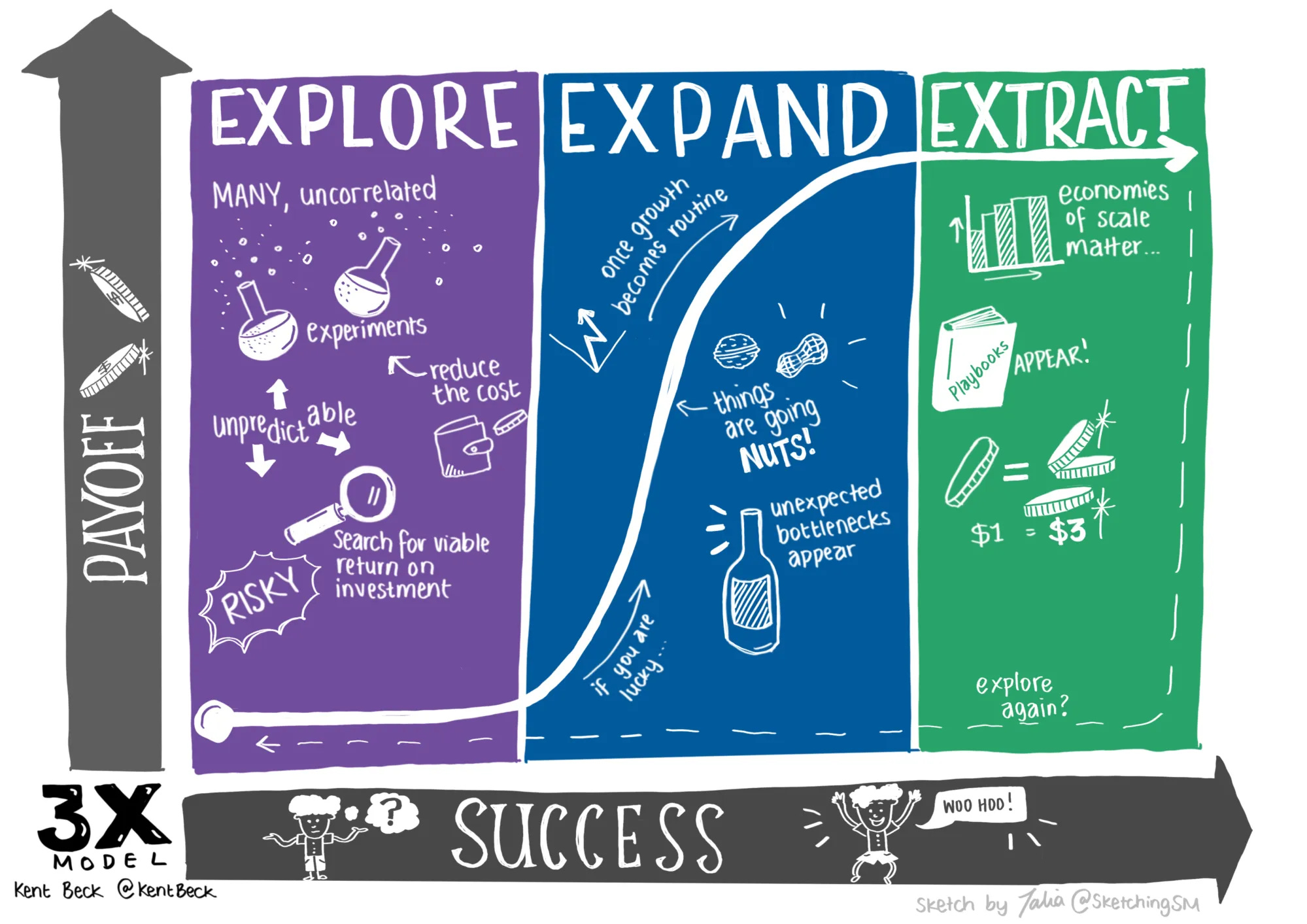
”sketch by Talia @sketchingSM”
I have often worked with teams that struggle with frequent changes in the product (I also struggled a lot). These teams may tend to resist change, not because they are unable to make the necessary changes, but because they do not want to have to make so many changes so often. That’s why I believe it can be very helpful to understand the Explore, Expand, and Extract phases of a product's lifecycle are important for developers and testers on a product team.
Because by understanding this lifecycle, you can better anticipate the needs and challenges of your product at each stage and plan your development and testing efforts accordingly without any frustration.
Explore phase: the focus is on experimentation and risk-taking in order to find a viable solution to a problem. You should be open to trying new ideas and approaches, even if they may not work out.
Expand phase: as the product becomes successful, you need to be ready to deal with unexpected challenges and bottlenecks.
Extract phase: Teams should focus on refining and optimizing the product based on the lessons learned during the previous phases.
If you want to learn more about the model, this video from Etsy Eng was helpful.
Please let me know your ideas via Twitter, Linkedin, or email.
Now, onto the eighth week’s episode.
Write tests smarter, not harder
Maxim Schepelin argues that the goal of testing should not be to simply increase code coverage, but rather to establish a reliable set of tests at different levels that provide a fast feedback loop for the codebase.
🔗 https://medium.com/booking-com-development/write-tests-smarter-not-harder-fb49c7ab89fd
How to Avoid December Burnout
Nicole Janz suggests that instead of trying to do everything on your to-do list, you should focus on completing one important task.
🔗 https://betterhumans.pub/how-to-avoid-december-burnout-84878755fd84
Experiment: The hidden costs of waiting on slow build times
I wanted to share with you a fascinating experiment that contains some strange and interesting findings:
If a developer is waiting on a build to run for one hour and doing nothing in that timeframe, the business is still spending $75 on average for that developer’s time in the United States.
🔗 https://github.blog/2022-12-08-experiment-the-hidden-costs-of-waiting-on-slow-build-times/